Donna — AI Sales Co-Pilot
UniAcco's sales agents were losing ~35% of every workday to non-selling admin: hunting property info across Excel, Slack and WhatsApp before ever talking to a student. Donna is the AI co-pilot that gives that time back: ranking properties, drafting the message, and sending it, with the agent's hands still on the wheel. No new headcount required.
What was actually broken.
- 01~35% of every workday lost to non-selling tasks: hunting property info, drafting messages, answering policy questions before a single lead is worked.
- 02Data lived in 3–5 places per shortlist: Excel sheets, property sites, Slack, WhatsApp, personal notes. No single source of truth.
- 03One shortlist took 30 minutes to 2 hours to build and send. At 10+ leads a day, the math ate most of the working hours.
- 04New-agent ramp took ~6 months. Senior agents held mental maps of the database that walked out when they left.
- 05Post-call CRM friction meant shortlists often went out late, or never. The next call had already started.
How I got it unstuck.
Reframing changed everything about prioritisation. The goal wasn't 'ship AI'; it was to give back the ~35% of the day the current system was consuming. AI was the tool that made the maths work, not the point.
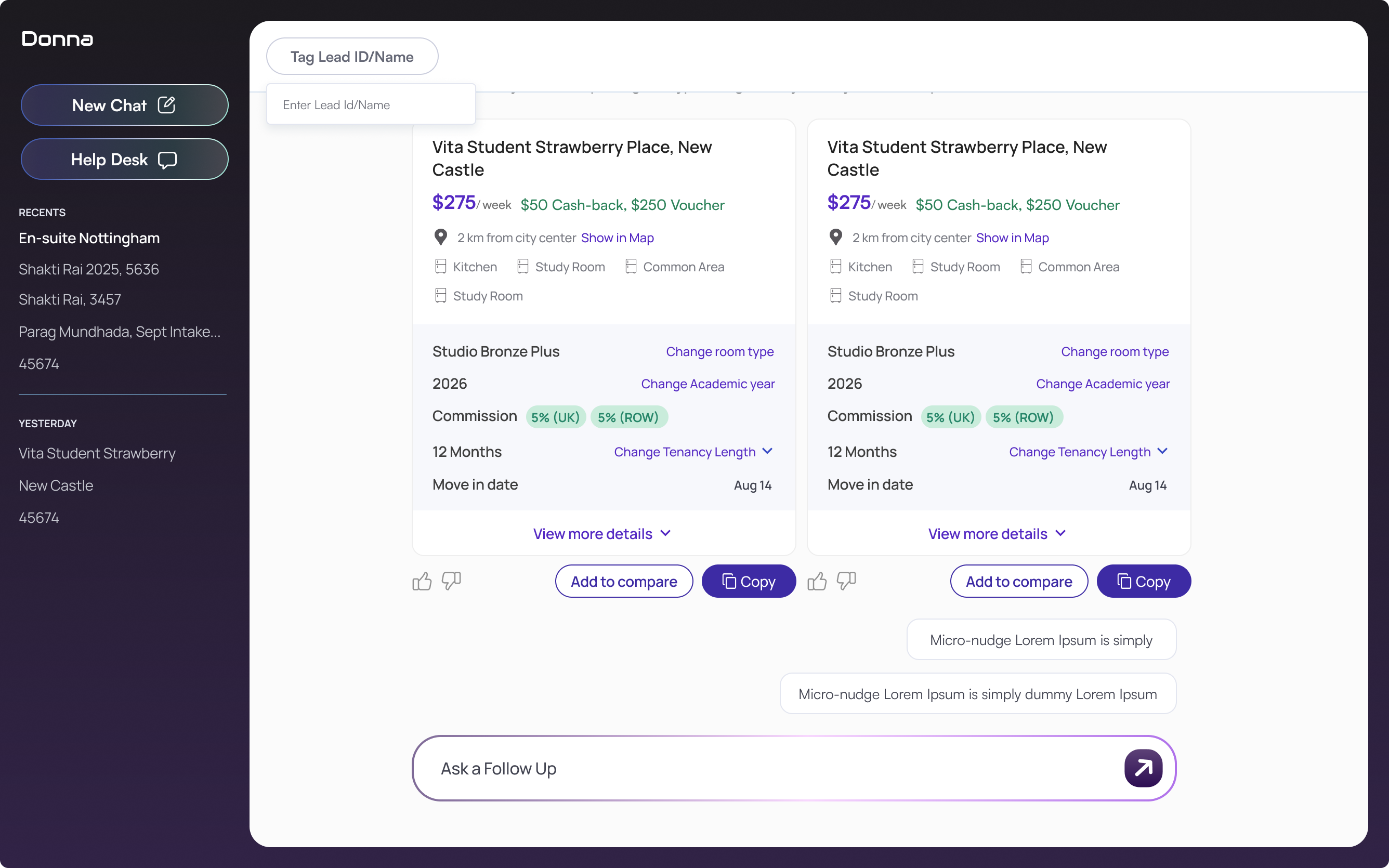
Agents needed a parallel workspace they could hold open beside the call, not a modal that interrupts, not a chat stream that competes for reading time. Donna opens as a dedicated browser tab per student, pre-loaded with that lead's full context.
Agents who feel the AI is acting without them disengage. Agents who see the reasoning, why this property, why this rank, start adding to compare unprompted. Every recommendation shows its 'why' before it shows its 'yes'.
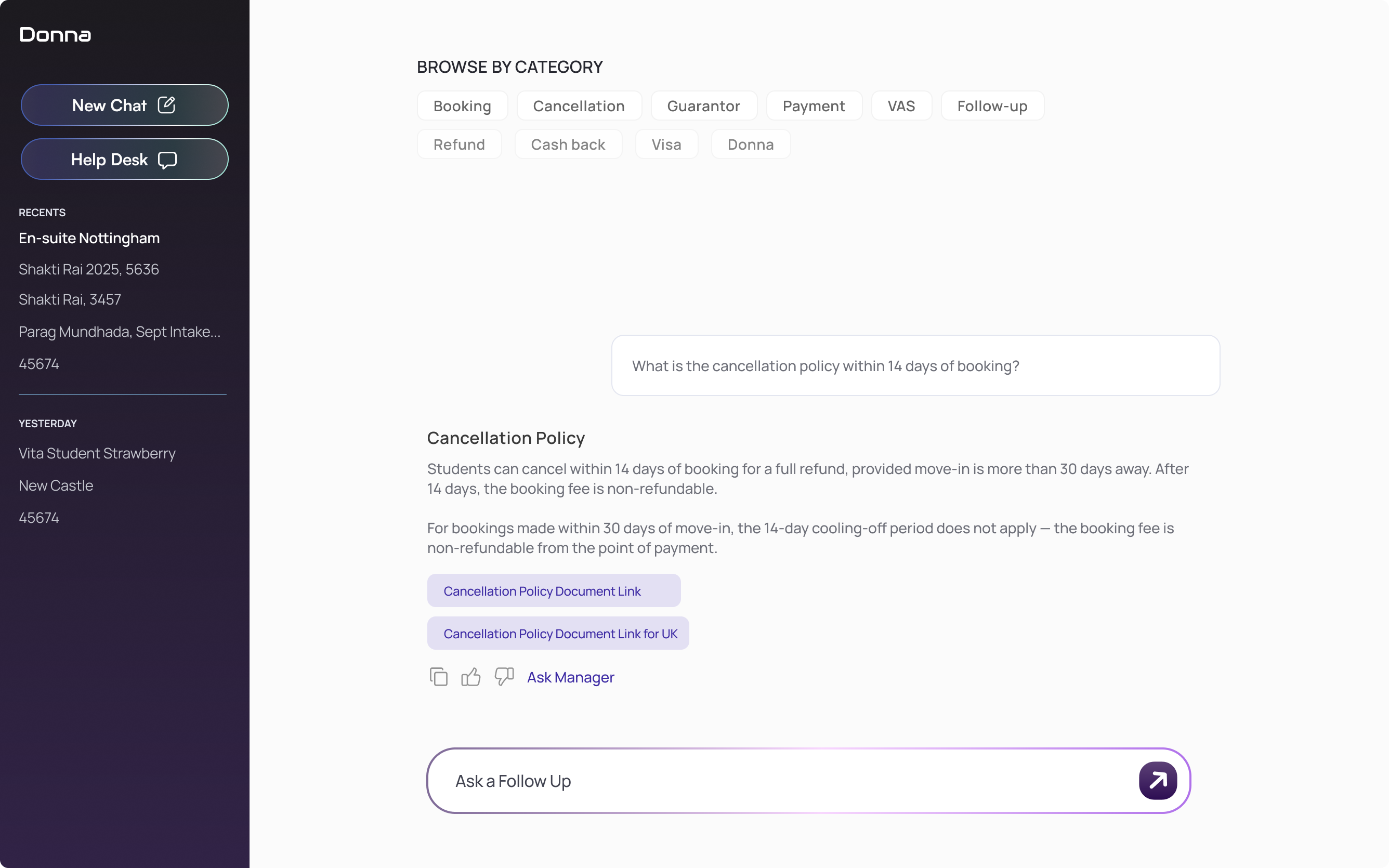
For compliance-sensitive answers, consistency is worth more than generative flexibility. The embedded help desk is pre-authored and keyword-matched across seven policy categories, with a manager escalation for edge cases. No hallucinations at the seam that matters most.
The moves that did the work.
One browser tab per student, opened from the lead record. Each tab title shows the student name: three open Donnas scan at a glance. 'Done' closes the tab and logs completion to the CRM.
Why: Agents handle 3–5 live students at once. A dedicated tab maps to muscle memory they already have; tab hygiene doubles as a lightweight workflow signal.
Result cards agents can jump into (price, distance, availability, commission) with a collapsible tray so the top three stay visible while deeper detail is a click away.
Why: Live calls reward scanning, not reading. Cards let the eye pick the answer without pulling attention off the student.
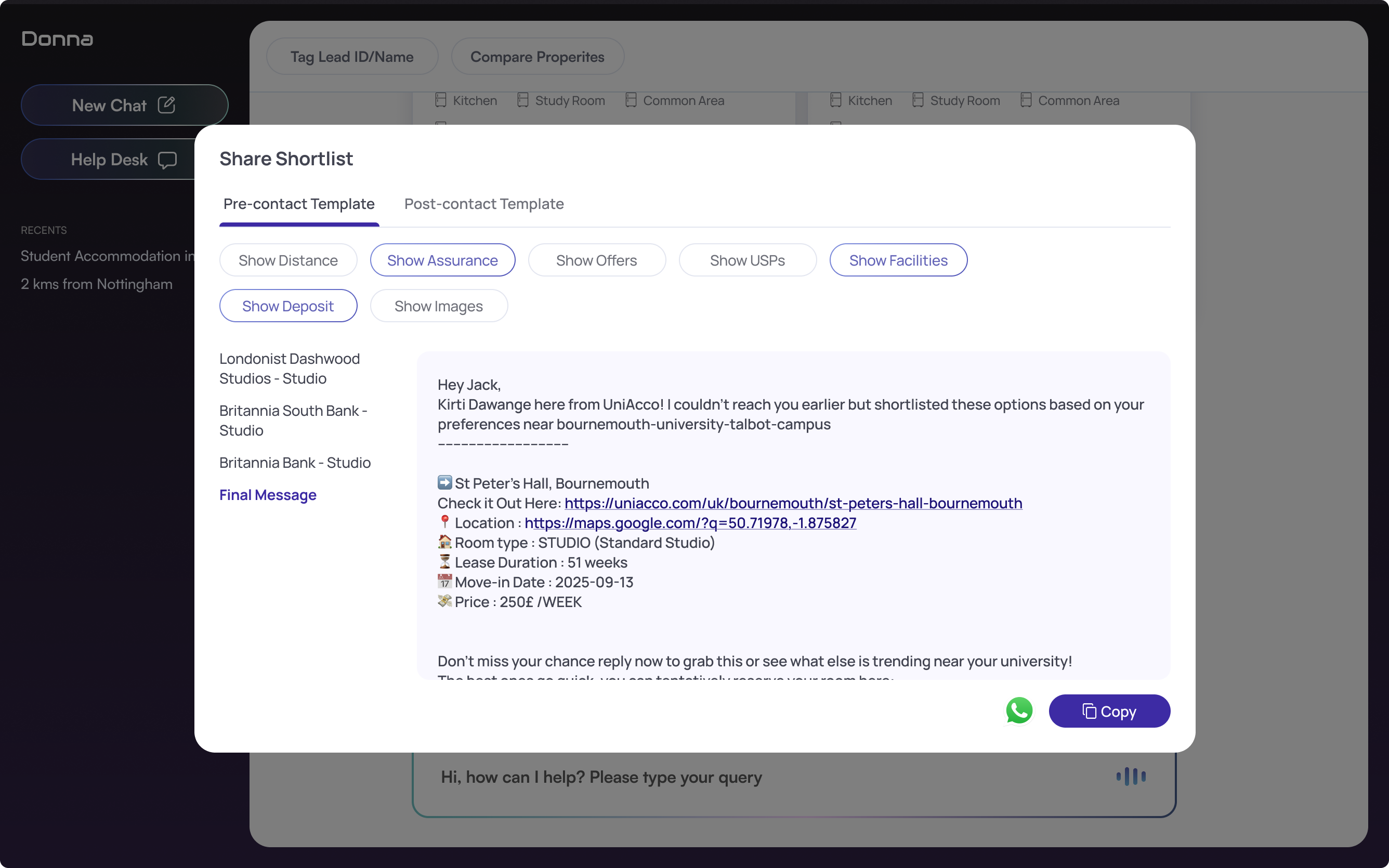
AI drafts the message with properties pre-filled; agent reviews inline, edits tone, adds a personal note, taps send. Message ships via WhatsApp or email without ever leaving Donna.
Why: AI earns trust through control, not convenience. The message has to feel like it came from the agent, because it did.
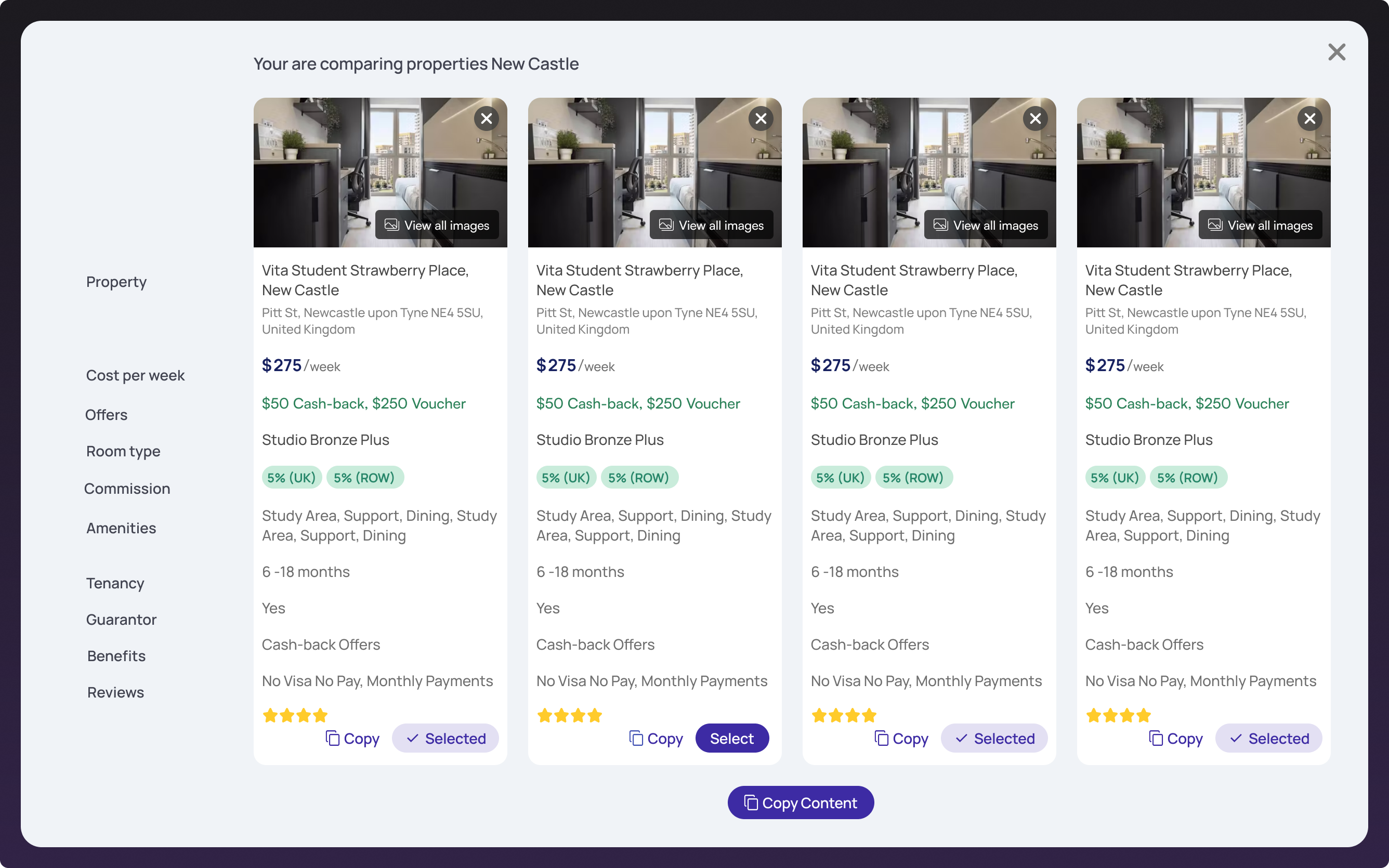
A side-by-side comparison table built live from properties the agent picks. Differences highlighted. Toggle between detailed and summary view.
Why: The most common mid-call question is a comparison. Structure the answer so it takes a glance, not a sentence.
An embedded help desk covering seven common categories, cancellations, guarantors, VAS, booking, payment, follow-up, house rules, with a manager-CTA for anything out of scope. Fast, consistent, safe.
Why: For policy answers, consistency > cleverness. The rare edge case escalates gracefully to a human. No dead ends, no hallucinations.
How I moved the room.
The original ask was 'build a sales AI'. In week one I made the case that the ceiling wasn't intelligence, it was time: ~35% of every agent day was burning on non-selling work. Once the PM adopted the frame, it rewrote our prioritisation stack. Every feature had to first answer 'how many minutes does this give back?' before it earned space in the sprint.
For policy, I argued against LLM generation, a position the AI/ML team initially pushed back on. We ran a two-week hardening spike alongside a keyword-matched prototype; the LLM was accurate most of the time and hallucinated a cancellation clause once. Once wasn't survivable in a compliance space where a wrong booking clause can send a student into an unrecoverable dispute. We shipped consistency over cleverness, and kept the AI where it earned trust.
A dedicated tab per student was a non-trivial integration ask: new session state, deep-links from lead records, close hooks writing back to the CRM. I brought the engineers into two sessions of agent-shadowing so they saw the three-parallel-conversations reality before we scoped the work. The build came in on estimate; the pattern they cared about most, adoption, is the metric that tracked strongest.
“Donna works when agents stop thinking about it. The goal was never to ship an AI tool, it was to give a fixed-headcount sales team capacity they didn't have before. Reframing this as a capacity project, not a UX project, changed every prioritisation call after it.”
Test assumptions, not designs. Three bets could have broken Donna: trust in AI ranks, willingness to edit drafted messages, and whether an embedded help desk could replace the KB. Prototype sessions targeted each one before a pixel of UI was polished.
Live-call behaviour and post-call behaviour aren't the same design problem. A diary study alongside interviews would have caught that earlier, I'd start there next time.
Define the measurement framework before the first screen. Metrics-first would have sharpened feature prioritisation from week one instead of week eight.